ELIAS Alliance Manchester Node

Activities

Like every ELIAS node, Manchester works across entrepreneurship, education and research.

Entrepreneurship

The node fosters value creation through a translational AI ecosystem that connects frontier research with innovation, entrepreneurship, industry and policy. With Unit M, the Turing Innovation Catalyst (TIC), IBIC, the Masood Entrepreneurship Centre, the Cambridge–Manchester Innovation Partnership and Bionow, it supports venture creation, start-up incubation and acceleration, industrial collaboration, technology transfer and commercialisation.

Researchers and students have access to sciencepreneurial training, mentoring, investor networks, innovation programmes and translational funding. Industrial partners including Fujitsu, Matillion and Manchester Airport Group provide routes to deploy AI across digital technologies, critical infrastructure, advanced engineering, life sciences and data-driven innovation.

Through ELIAS, ELLIS and its European partners, the node helps start-ups and research teams take part in cross-European initiatives, including the AI Launchpad, for access to talent, markets and investors across Europe.

Education

At doctoral level, the node connects with Manchester’s doctoral training ecosystem, including the CDT in AI for Decision Making in Complex Systems, the RAINZ CDT and interdisciplinary programmes across data science, engineering, sustainability, health, business and digital technologies.

The node supports participation in the ELIAS Alliance Innovation PhD, with student mobility, joint workshops, summer schools and collaborative projects with the Cambridge, Finland, Franconia and Barcelona nodes, and international exposure through partners such as AIST Japan.

At undergraduate and master’s level, node members teach artificial intelligence, machine learning, data science, optimisation, natural language processing, business analytics and responsible AI, exposing students to trustworthy AI, innovation, entrepreneurship and societal impact.

Research

The node contributes to open-source foundation model research across health, life sciences, finance, language technologies and scientific discovery: health foundation models, domain-specialised and multilingual LLMs, life-science AI, trustworthy health AI and open-source AI, developing models, benchmarks, datasets, agents and evaluation frameworks for reusable and transparent AI.

Frontier AI programme 1

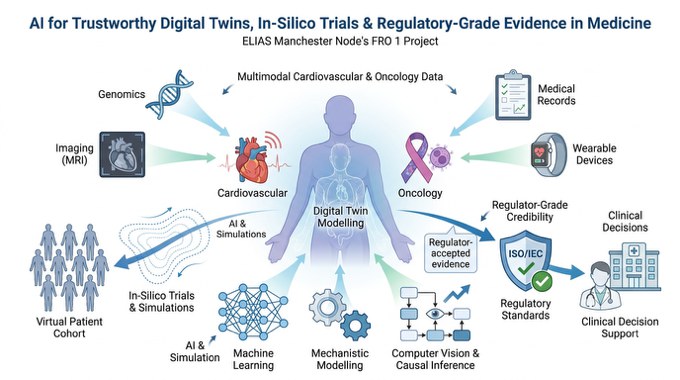
Trustworthy AI for digital twins, in-silico trials and regulatory-grade evidence

Translating foundation models, multimodal learning, causal AI, scientific machine learning and digital twins into regulator-accepted evidence. Through UK CEiRSI, led by ELLIS Fellow Prof. Alejandro Frangi, the BHF Manchester Centre of Research Excellence, the UKRI-MRC Centre of Research Excellence in Exposome Immunology and the CRUK RadNet Manchester Centre, the node builds trustworthy digital twins, virtual patient cohorts and in-silico trials.
Frontier AI programme 2

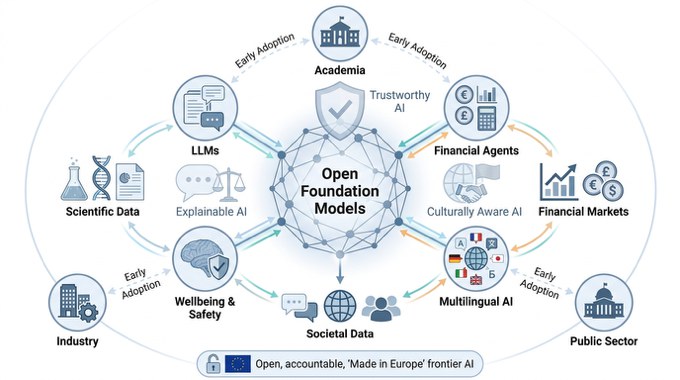
Open foundation models, agentic AI and trustworthy AI

Domain-specialised foundation models, agentic AI systems, multilingual technologies, benchmarks, datasets and evaluation frameworks built for broad adoption. Building on strengths in natural language processing, financial AI, mental health AI and misinformation detection, through initiatives such as FinAI, MentaLLaMA and ConspEmoLLM.

Financial AI at NaCTeM →

Frontier AI programme 3

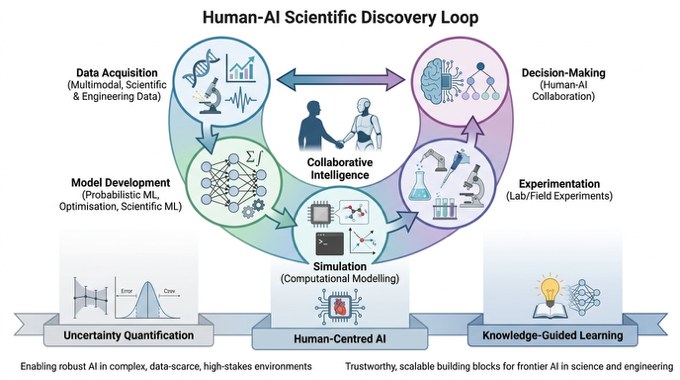
AI foundations for scientific discovery, collaborative intelligence and complex systems

Probabilistic machine learning, optimisation, scientific machine learning, human-centred AI, uncertainty quantification and knowledge-guided learning: methods that let AI work reliably in complex, data-scarce and high-stakes settings, underpinning AI-assisted discovery, experimental design, engineering optimisation and biomedical research.